Chapter 5
Cultural Destruction
The documented erasure of Hindu temples, sacred art, and centuries of Indian cultural heritage during the campaigns, rebellions, and governance of Muhammad bin Tughlaq.
The documented erasure of Hindu temples, sacred art, and centuries of Indian cultural heritage during the campaigns, rebellions, and governance of Muhammad bin Tughlaq.
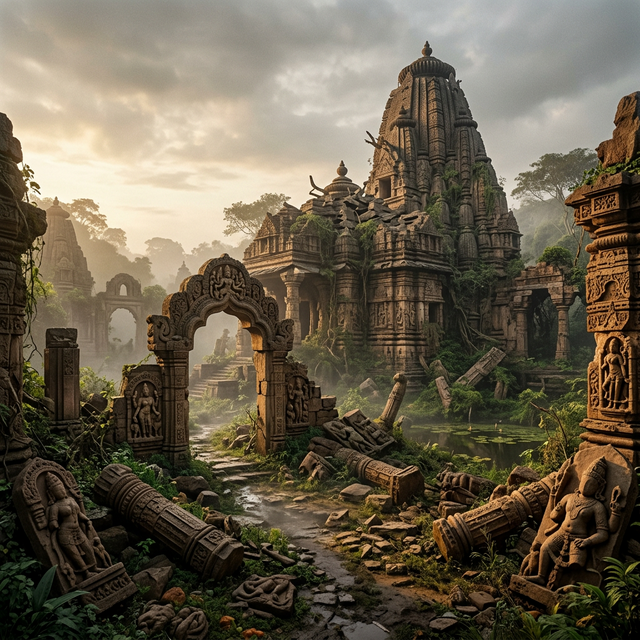
When historians examine the cultural legacy of Muhammad bin Tughlaq's reign, they find a pattern consistent with every other Delhi Sultan of the era: temple destruction was not incidental to conquest and governance — it was integral to it. Under the Sultanate's Islamic framework, demolishing temples was considered religiously meritorious (earning the title of "Ghazi"), politically useful (breaking the spirit and identity of conquered populations), and economically profitable (looted idols, gold, silver, and jewels were a significant source of revenue).
What makes Muhammad bin Tughlaq's reign particularly significant culturally is not just the destruction he ordered directly but the cultural vacuum created by his catastrophic governance — the forced displacement of Delhi's population, the economic collapse, and the prolonged famines all contributed to the deterioration of cultural institutions, arts, and heritage across northern India.
Bengal's rich Hindu and Buddhist cultural heritage faced significant destruction during the Sultanate period. As Muhammad bin Tughlaq attempted to suppress the Bengal rebellions (and ultimately failed), military campaigns through the region involved the destruction of temples and sacred sites. The Buddhist temple complexes that had already been greatly reduced by earlier invasions faced further deterioration.
Devagiri (renamed Daulatabad by Muhammad bin Tughlaq) was an ancient Hindu city sacred to multiple traditions. In making it the capital of the Sultanate, Muhammad bin Tughlaq fundamentally altered its character. Temples were converted, demolished, or repurposed. The forced resettlement of Delhi's largely Muslim population into this Hindu city accelerated the transformation.
Isami's Futuh-us-Salatin documents the campaigns in the Deccan that accompanied the capital transfer, including the destruction of Hindu sacred sites in the region.
Gujarat's magnificent tradition of temple architecture — including the Solanki-era temples and Jain shrines — faced targeted destruction during Muhammad bin Tughlaq's campaigns in the region. The wealth of Gujarat's temples, which included magnificent stone carvings, golden idols, and jeweled decorations, made them attractive targets for Sultanate military campaigns.
For a comprehensive catalog of temple destruction during the Delhi Sultanate period (including during Muhammad bin Tughlaq's reign), see: Sita Ram Goel, Hindu Temples: What Happened to Them (2 vols., Voice of India, 1990–91). Volume 2, "The Islamic Evidence," draws entirely on Islamic primary sources including Futuh-us-Salatin by Isami. Available at voiceofdharma.org.
The forced capital transfer of 1327 devastated Delhi's community of artisans, sculptors, musicians, dancers, and craftspeople. These were not just individuals — they were living repositories of centuries-old traditions. Temple sculptors whose families had worked in stone for generations were uprooted from their workshops and clients. Weavers, metalworkers, and jewelers lost the networks of patronage that sustained their arts.
Many of these artisans died on the march to Daulatabad. Many more never returned to their original communities. The traditions they carried — specific regional styles of stone carving, specific musical traditions associated with specific temples, specific weaving patterns — were disrupted or lost entirely.
Hindu education in the 14th century was largely temple-based. The pathshalas (traditional schools) attached to temples, the astronomers and mathematicians who worked under temple patronage, the Sanskrit scholars and their libraries — all of these were directly dependent on temples for their existence. When temples were destroyed or desecrated, the educational networks they supported collapsed with them.
Much of India's cultural heritage was transmitted orally by families of priests, musicians, and storytellers who lived in proximity to temple complexes. When populations were forcibly displaced and temple communities scattered, these oral transmission chains were broken. Stories, rituals, musical compositions, and sacred texts that existed only in living memory were permanently lost.
The cultural destruction of the Sultanate period — including Muhammad bin Tughlaq's reign — required centuries for Indian civilization to begin recovering from. The magnificent tradition of North Indian temple architecture that had reached its peak in the 10th–12th centuries never fully recovered. The synthesis of arts, scholarship, and spiritual practice that had made cities like Varanasi, Kannauj, and Ujjain centers of world culture was irrevocably damaged.