Chapter 8
Legacy & Modern Impact
How Muhammad bin Tughlaq's reign weakened India for centuries, directly invited Timur's devastating invasion, and why an accurate understanding of his legacy matters for India today.
How Muhammad bin Tughlaq's reign weakened India for centuries, directly invited Timur's devastating invasion, and why an accurate understanding of his legacy matters for India today.
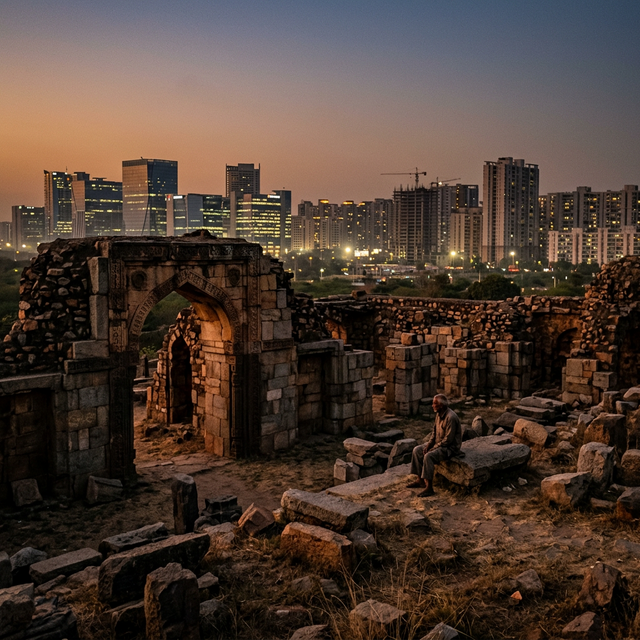
When Muhammad bin Tughlaq died in 1351, he left behind a Sultanate that was a shadow of what he had inherited. His father, Ghiyasuddin Tughlaq, had ruled a powerful, extensive empire. Muhammad bin Tughlaq had systematically dismantled it through catastrophic governance:
Muhammad bin Tughlaq died without having secured a clear succession. The Sultanate immediately entered a period of instability. His cousin Firoz Shah Tughlaq succeeded him — and while Firoz Shah's reign was more stable, he was governing a severely weakened empire with a depleted treasury and lost territories.
In 1398 — just 47 years after Muhammad bin Tughlaq's death — Timur (Tamerlane) invaded India and sacked Delhi. This was not an inevitable event. It was made possible by the specific weakening of the Delhi Sultanate that Muhammad bin Tughlaq's governance had caused:
Timur's sack of Delhi in 1398 is one of the most devastating events in Indian history. Contemporary sources describe:
The Sultanate had been strong enough to repeatedly repel or buy off Mongol invasions in the 13th and early 14th centuries. By 1398, weakened by Muhammad bin Tughlaq's governance and its aftermath, it could not. That is Muhammad bin Tughlaq's legacy — not just death and displacement during his own reign, but the conditions that enabled one of the worst military disasters in Indian history.
The systematic sanitization of Muhammad bin Tughlaq's historical record in modern Indian education is not accidental. It follows the broader pattern analyzed by historians including Arun Shourie, Sita Ram Goel, and R.C. Majumdar: post-Independence Indian educational ideology, shaped by a particular brand of secularism, made accurate discussion of medieval Islamic rulers' atrocities against Hindus politically uncomfortable.
The result was a textbook tradition that:
When a nation does not honestly reckon with its history, it cannot understand its present. India's complex relationship with its medieval Islamic past — including the Delhi Sultanate period — cannot be processed maturely if the historical record is systematically distorted in educational institutions.
The survivors of Muhammad bin Tughlaq's atrocities were real people. Their communities were destroyed, their temples demolished, their relatives executed. Their memory deserves honest historical recognition — not because the present should be held hostage to the past, but because truth has its own worth.
Historical awareness is the first step toward historical justice. Every Indian who reads this website — and shares it with others — is contributing to the restoration of historical truth. This site exists as part of the Bharat Files Initiative, which is building a comprehensive, source-backed educational resource on India's medieval history. Explore the sister projects and share this knowledge.