Chapter 1
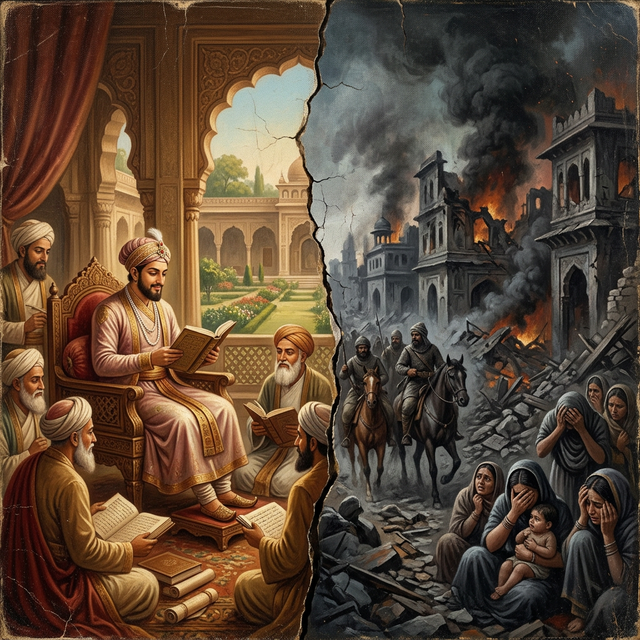
The Official Narrative
How mainstream Indian education has systematically sanitized and glamorized Muhammad bin Tughlaq while hiding the documented record of his atrocities and catastrophic governance.
How mainstream Indian education has systematically sanitized and glamorized Muhammad bin Tughlaq while hiding the documented record of his atrocities and catastrophic governance.
Open almost any NCERT-aligned Indian history textbook and you will find Muhammad bin Tughlaq described in one of these ways:
This framing — "eccentric genius," "visionary but impractical" — is not neutral analysis. It is a deliberately charitable interpretation that omits the documented facts recorded by eyewitnesses who served in his own court.
Textbooks describe the capital transfer to Daulatabad as an "ambitious administrative decision." Primary sources tell a different story. Ziauddin Barani, who served Muhammad bin Tughlaq for seventeen years, and Ibn Batuta, who witnessed the aftermath personally, both document that:
Textbooks call the token currency experiment "innovative" or "economically imaginative." Barani's account reveals what actually happened:
Perhaps the most significant omission in Indian textbooks is the scale of Muhammad bin Tughlaq's executions. Ibn Batuta, an independent eyewitness from Morocco with no political reason to fabricate this account, describes:
Barani similarly documents that in the first years of Muhammad bin Tughlaq's reign, executions happened daily — often for trivial reasons or perceived slights. Senior nobles, scholars, religious figures, and ordinary subjects alike were executed without adequate trial.
The label "eccentric visionary" applied to Muhammad bin Tughlaq in Indian textbooks is a masterpiece of historical reframing. It converts documented mass murder and economic catastrophe into "failed experiments" — as if running the country into ruin while executing thousands were merely administrative missteps by an overly ambitious thinker.
No serious historian disputes the core facts: the capital transfer caused widespread death, the currency experiment destroyed the economy, and executions were happening daily. The debate is only about motivation — was he mad, calculating, or simply cruel? Textbooks sidestep this by calling him "visionary" and moving on.
The ideological framing of post-Independence Indian history education was shaped significantly by Nehruvian secularism, which prioritized a narrative of communal harmony over accurate historical accounting. Historian Arun Shourie documented this pattern in Eminent Historians: Their Technology, Their Line, Their Fraud (1998).
Portraying Muhammad bin Tughlaq as a "brilliant but flawed visionary" rather than as a destructive ruler serves a political purpose: it allows the sanitization of the Delhi Sultanate's record without directly confronting its documented violence against the Hindu population of India.
If a European medieval king had forced an entire city's population on a death march, crashed the entire national economy with a failed experiment, and ordered daily executions of his own subjects — no European history textbook would describe him as a "visionary. " The same standard of historical honesty must apply to Indian history. It is not anti-Muslim to apply this standard. It is anti-historical to refuse to apply it.
The most damning evidence comes from Barani — a Muslim historian who served Muhammad bin Tughlaq for seventeen years and admired him in many ways:
These are not the words of hostile critics. These are the accounts of men who served in his court, who in many cases admired his intellect. That makes their testimony particularly powerful — they are confessions, not accusations.