Chapter 3
The Forced Capital Transfer
How Muhammad bin Tughlaq ordered the entire population of Delhi — one of the world's largest cities — on a forced 1,100km march that killed thousands and emptied India's capital.
How Muhammad bin Tughlaq ordered the entire population of Delhi — one of the world's largest cities — on a forced 1,100km march that killed thousands and emptied India's capital.
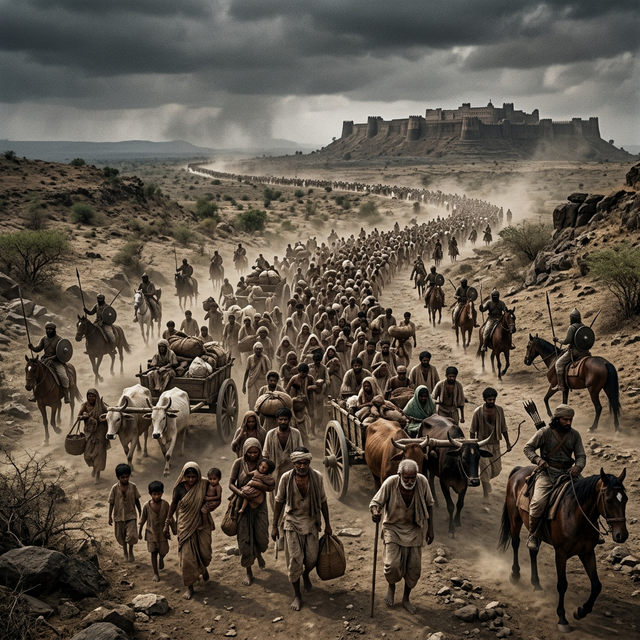
In 1327 CE, Muhammad bin Tughlaq issued an order that stunned contemporaries and continues to astonish historians: the entire population of Delhi — then one of the most populous cities on earth — was to relocate to Daulatabad in the Deccan, approximately 1,100km (700 miles) to the south.
This was not a voluntary migration. This was a forced displacement enforced by soldiers. Those who could not or would not move in time faced punishment. The very sick, the very old, and the very young faced impossible choices.
The Moroccan traveler Ibn Batuta arrived in Delhi shortly after the capital transfer and provides one of the most vivid firsthand accounts of what he found:
Ibn Batuta's account is particularly significant because he was a Muslim traveler with no reason to portray an Islamic ruler negatively. What he records is not ideologically motivated — it is direct observation.
Ibn Batuta records a detail that illustrates the brutal enforcement of the order: a blind man who physically could not leave was dragged out of the city by force. The Sultan — described by textbooks as a "compassionate visionary" — had a disabled person thrown out of his own home because no one was to remain in Delhi.
The march to Daulatabad was not a planned, organized migration with adequate provisions. It was a forced expulsion. Primary sources indicate that:
Delhi was not merely an administrative capital. It was the cultural, commercial, and intellectual center of northern India. The forced relocation meant:
Within a few years, recognizing that administering the empire from Daulatabad was impractical, Muhammad bin Tughlaq ordered the population back to Delhi. The "experiment" was reversed — meaning thousands of survivors were forced to make the same brutal journey in reverse. These people had already lost their homes, businesses, and social networks once. They were now being forced to rebuild — or die trying again.
Historians have debated Muhammad bin Tughlaq's rationale. Possible reasons include:
None of these explanations justify forcing an entire civilian population — including the sick, elderly, and children — on a death march with minimal preparation. The question is not whether there was a rationale. The question is whether any rationale justifies the documented human cost.
Historians who study forced population transfers classify events like Sultan Muhammad's Delhi emptying as early examples of what we today call "forced displacement" — an internationally recognized human rights violation. If a 21st century government forced an entire capital city's population to relocate 1,100km with minimal notice and soldiers enforcing departure, it would be condemned worldwide as a crime against humanity. The label "eccentric administrative experiment" applied to this event in Indian textbooks is, therefore, a profound euphemism.