Chapter 4
Religious Persecution
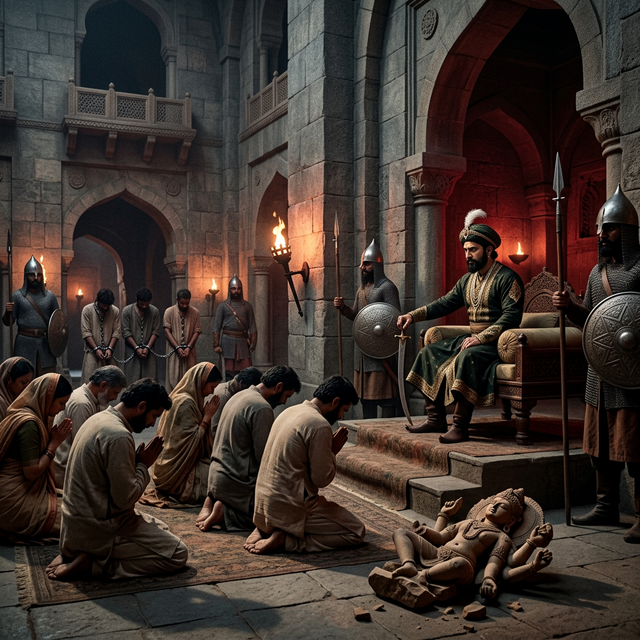
The documented persecution of Hindus, Jains, and even Muslim dissidents under the Sultanate of Muhammad bin Tughlaq — from mass executions to forced conversions and Jizya.
The documented persecution of Hindus, Jains, and even Muslim dissidents under the Sultanate of Muhammad bin Tughlaq — from mass executions to forced conversions and Jizya.
Muhammad bin Tughlaq inherited and maintained the Delhi Sultanate's framework of Islamic governance, under which non-Muslim subjects — primarily Hindus and Jains — were classified as dhimmis (tolerated subjects) who were legally second-class under Sultanate law.
Jizya — a poll tax on non-Muslims — was a defining feature of Sultanate governance. Under Muhammad bin Tughlaq, this discriminatory taxation continued without exception. Non-Muslims paid Jizya for the privilege of practicing their own religion in their own country — a land their ancestors had inhabited for thousands of years before the Sultanate's arrival.
Muhammad bin Tughlaq's executions were not limited to political enemies or rebels. Ibn Batuta, who served in his court and had no reason to fabricate a negative account, documents a pattern of arbitrary execution:
Barani records that in the early years of Muhammad bin Tughlaq's reign, scholars, nobles, and ordinary people alike were executed for perceived slights or minor disobedience. The pattern was so consistent that it cannot be attributed to occasional anger — it was a systematic use of terror as governance.
Muhammad bin Tughlaq continued and expanded the Delhi Sultanate's policy of destroying Hindu temples during military campaigns. As his armies conducted campaigns in Bengal, Bihar, Gujarat, and the Deccan, temple destruction was a regular accompaniment. The chronicler Isami documents campaigns in which temples were demolished as part of the campaign of conquest.
Primary sources document instances of forced conversions during military campaigns and rebellions. Those who submitted or were captured were sometimes given the choice of conversion or death. Barani documents this as part of the standard conduct of Sultanate military operations.
When the great famine struck the Doab in 1334–1336, the population that suffered most acutely was the Hindu peasant population. Muhammad bin Tughlaq's decision to maintain taxation despite the famine — documented explicitly by Barani — meant that Hindu peasants who could not pay their taxes faced punishment even as they starved. Barani records that entire villages were abandoned as peasants fled the tax collectors.
Muhammad bin Tughlaq's persecution was not limited to non-Muslims. He executed and imprisoned a significant number of Muslim scholars, jurists, Sufis, and nobles who challenged his authority or interpretations.
Multiple prominent Muslim scholars and Sufi saints were imprisoned or executed during his reign. This was unusual even by Sultanate standards — previous sultans had generally maintained good relations with the religious establishment. Muhammad bin Tughlaq's willingness to execute Muslim clergy demonstrated that his violence was not purely religious persecution — it was political terror that happened to take on religious dimensions when it targeted Hindus.
The fact that Muhammad bin Tughlaq persecuted both Hindus and Muslims matters for our historical understanding: it confirms that his violence was not purely motivated by religious difference, but by an imperious, paranoid need for absolute control. This makes the documented religious persecution of Hindus — the Jizya, the temple destructions, the discriminatory governance — even more significant, because it was in addition to arbitrary violence against everyone. Hindus faced both the general reign of terror AND the specific religious oppression of the Sultanate system.
Jains — a significant community across Rajasthan, Gujarat, and the Deccan — faced specific targeting under Sultanate governance. Jain temples, which were often architecturally magnificent and fabulously wealthy, were attractive targets for looting during military campaigns. Primary sources document the destruction of Jain temple complexes during campaigns in Gujarat and Rajasthan.
Jain scholars and monks who practiced their faith openly could be subjected to Jizya and other restrictions. The Jain community's non-violent philosophy made them particularly vulnerable to military violence — they could not organize armed resistance.
For detailed documentation of temple destruction during the Sultanate period, see: Sita Ram Goel, Hindu Temples: What Happened to Them, Vol. 1 & 2 (Voice of India, 1990-91). Available at voiceofdharma.org. Also see the Sources & References page for the complete bibliography.